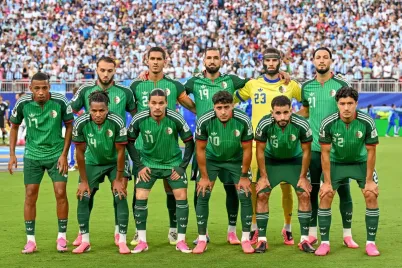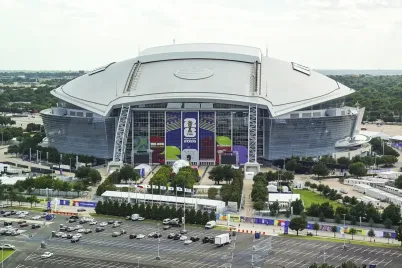

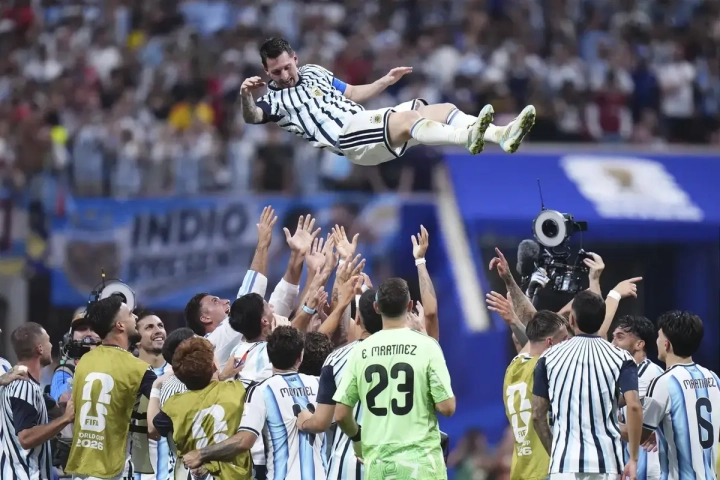
The heavy, humid air of the Atlanta Stadium bore witness to a footballing miracle on Tuesday evening. For 78 minutes, the global sporting community stood on the precipice of a monumental shock. Egypt, resolute, disciplined, and utterly fearless, were two goals to the good against the reigning world champions, Argentina. The Pharaohs were mere moments away from scripting the greatest upset of the 2026 FIFA World Cup, threatening to abruptly end Lionel Messi’s final dance on the international stage.
Yet, football, in its purest and most intoxicating form, thrives on the impossible. In the space of eleven breathless minutes plus stoppage time, Argentina orchestrated a spectacular 3-2 comeback that will echo through the annals of sporting history. Late strikes from Cristian Romero, Messi himself, and a dramatic 93rd-minute winner from Enzo Fernández shattered Egyptian hearts and propelled Lionel Scaloni’s men into the quarter-finals.
To truly appreciate the magnitude of Tuesday’s incredible revival, one must first dissect the drama that unfolded in Georgia, before looking back at the rich, dramatic tapestry of the World Cup’s greatest historical turnarounds.
The Anatomy of the Atlanta Miracle
Entering the Round of 16 clash, very few pundits gave Egypt a realistic chance of troubling the world champions. However, from the very first whistle, it was evident that the Pharaohs had brought a tactical masterclass to the pitch. Operating in a deeply compact 4-2-3-1 shape, they successfully denied Argentina any space through the central channels, forcing the South Americans to rely on ambitious cross-field passes.
The tactical discipline paid off spectacularly in the 15th minute. A well-worked set piece saw Yasser Ibrahim brilliantly escape the marking of Lisandro Martínez, rising to power a downward header beyond Emiliano Martínez. The reigning champions were undeniably rattled.
A golden lifeline presented itself in the 20th minute when Argentina were awarded a penalty. Yet, even the seemingly infallible Lionel Messi proved human under the immense pressure. His spot-kick was brilliantly saved by Egyptian goalkeeper Mostafa Shobeir, Messi’s second penalty miss of the tournament.
As the second half unfolded, Argentina dominated possession but struggled to penetrate the organised Egyptian defensive structure. Instead, the underdogs struck again in the 67th minute with a devastating counter-attack. Marwan Attia intercepted a loose pass and released Mohamed Salah, whose intelligent cross found Mostafa Ziko completely unmarked at the back post. Ziko swept his finish home, making it 2-0 and leaving the world champions staring down the barrel of an extraordinary elimination.
The turning point finally arrived in the 79th minute, born of sheer desperation. Standing over a crucial free-kick, Lionel Messi delivered a teasing, pinpoint cross to the far post. Cristian Romero anticipated the flight perfectly, leaping above Karim Hafez to power a firm header into the corner of the net.
The goal entirely shifted the psychological momentum. Just four minutes later, Rodrigo De Paul intercepted a long clearance from Shobeir near the halfway line. Julián Álvarez drove directly at the retreating defence before slipping a perfectly weighted reverse pass into Messi’s path. The captain took one composed touch and slid a low finish into the bottom corner, redeeming his earlier penalty miss and levelling the tie at 2-2.
As the game ticked into stoppage time, Egypt retreated deeper into their own half, desperately hoping to force extra time. But the decisive blow landed in the 93rd minute. Arriving from deep midfield, Enzo Fernández timed his run to perfection, meeting a cross to steer a dramatic, looping header past Shobeir. The 3-2 victory sparked wild, emotional celebrations among the Argentine players, keeping their title defence miraculously intact.
Echoes of History: The World Cup’s Greatest Comebacks
Argentina’s phenomenal revival immediately sparked debates across the footballing landscape: where does the ‘Atlanta Miracle’ rank in the pantheon of World Cup comebacks? The tournament’s history is littered with matches that have defied logic, where teams have dragged themselves from the absolute abyss to secure eternal glory.
Here are some of the most spectacular turnarounds in World Cup history.
The Miracle of Bern: West Germany 3-2 Hungary (1954 Final)
Perhaps the most famous comeback in the history of the sport occurred during the 1954 World Cup Final in Switzerland. The ‘Magical Magyars’ of Hungary arrived as the undisputed heavyweights of world football. Undefeated in 32 consecutive matches, they boasted a team featuring legends like Ferenc Puskás and Sándor Kocsis.
Within eight minutes of the final kicking off, Hungary had established a commanding 2-0 lead through Puskás and Zoltán Czibor. A humiliation seemed inevitable. However, West Germany clawed their way back into the tie with relentless determination. Max Morlock reduced the deficit in the 10th minute, and Helmut Rahn equalised in the 18th. The match remained a tense stalemate until the 84th minute, when Rahn collected the ball on the edge of the penalty area and fired home the winner, securing West Germany’s first World Cup title and cementing “Das Wunder von Bern” into sporting folklore.
The Eusébio Show: Portugal 5-3 North Korea (1966 Quarter-Final)
At Goodison Park in 1966, the tournament debutants from North Korea threatened to pull off one of the greatest shocks in sporting history. Within an astonishing 25 minutes, the North Koreans had torn the Portuguese defence to shreds, taking a scarcely believable 3-0 lead thanks to goals from Pak Seung-zin, Li Dong-woon, and Yang Seung-kook.
Enter Eusébio. The legendary ‘Black Panther’ took it upon himself to single-handedly rescue his nation. Displaying a combination of terrifying pace, power, and clinical finishing, Eusébio scored four consecutive goals, two from the penalty spot, to completely dismantle the North Korean advantage. José Augusto added a fifth in the dying moments to seal a 5-3 victory, completing a one-man rescue mission that remains unparalleled in World Cup knockout football.
The Rostov Rollercoaster: Belgium 3-2 Japan (2018 Round of 16)
A modern classic that shares striking similarities with Argentina’s recent triumph. During the 2018 World Cup in Russia, a highly unfancied Japanese side completely stunned Belgium’s ‘Golden Generation’ by taking a 2-0 lead early in the second half through Genki Haraguchi and Takashi Inui.
With their tournament slipping away, Belgium manager Roberto Martínez made crucial tactical substitutions. Jan Vertonghen sparked the revival in the 69th minute with a bizarre, looping header from 20 yards out, before substitute Marouane Fellaini powered home an equaliser five minutes later. The defining moment arrived in the 94th minute: a sweeping, 14-second counter-attack that started with goalkeeper Thibaut Courtois rolling the ball to Kevin De Bruyne. De Bruyne drove through the midfield, Thomas Meunier crossed, Romelu Lukaku executed a brilliant dummy, and Nacer Chadli tapped home the winner with the very last kick of the game.
The Heat of León: West Germany 3-2 England (1970 Quarter-Final)
A fiercely contested rematch of the 1966 final, the 1970 quarter-final in Mexico saw England establish a comfortable 2-0 lead through Alan Mullery and Martin Peters. The defending champions appeared to be cruising into the semi-finals, prompting manager Sir Alf Ramsey to substitute key midfielder Bobby Charlton to save his legs for the next round.
That decision proved fatal. Freed from Charlton’s defensive attention, Franz Beckenbauer drove a low shot past Peter Bonetti in the 68th minute to ignite the German fightback. With eight minutes remaining, Uwe Seeler scored an incredibly improvised, looping backward header to level the tie and force extra time. The psychological damage had been done, and in the 108th minute, the perennial poacher Gerd Müller volleyed home the winner from close range, completing a painful reversal of fortune for the English.
The Legacy of the Turnaround
What separates a good team from a truly great team is the absolute refusal to accept defeat. Argentina in 2026, much like West Germany in 1954 or Belgium in 2018, demonstrated a psychological resilience that simply cannot be coached. They absorbed the immense pressure of the occasion and the shock of a 2-0 deficit, relying on the sheer quality of their superstars to drag them out of the mire.
For Egypt, the pain of the 93rd minute will linger for a generation, a bitter pill swallowed on the most unforgiving global stage. They executed a game plan that nearly produced the shock of the century, and depart the tournament with immense credit.
As Lionel Scaloni’s squad marches on to the quarter-finals, where they will face Switzerland in Kansas City, they carry with them the dangerous momentum of a team reborn. The ‘Atlanta Miracle’ will be spoken about in the cafés of Buenos Aires for decades to come, rightfully taking its place among the greatest comeback stories the FIFA World Cup has ever seen.