
The relentless, unforgiving crucible of knockout football reaches a crescendo this week as the 2026 FIFA World Cup delivers a quarter-final fixture dripping with historical resonance and tactical intrigue. On Thursday, 9 July 2026, tournament heavyweights France will lock horns with an unyielding Morocco side. Scheduled for a 21:00 BST kick-off beneath the towering floodlights of the Boston Stadium in Foxborough, Massachusetts, this encounter presents an unequivocally brutal equation. For the victors, a coveted place in the semi-finals and a step closer to global supremacy awaits; for the vanquished, nothing remains but an agonising departure from the world stage.
Geographical proximity, deep-rooted cultural ties, and recent sporting history combine to make this one of the most highly anticipated matches of the tournament. The narrative surrounding this knockout tie is impossible to ignore, as it serves as a direct rematch of the captivating 2022 World Cup semi-final in Qatar. On that historic night four years ago, France secured a 2-0 victory to extinguish Moroccan dreams and advance to the final. The European powerhouse arrives in North America burdened by the expectation of reaching a third consecutive World Cup final, seeking to cement this generation’s legacy as one of the greatest in the sport’s history. Conversely, the Atlas Lions are determined to prove that their groundbreaking run in the previous cycle was merely the foundation of a new era of sustained global competitiveness.
Les Bleus’ Flawless March
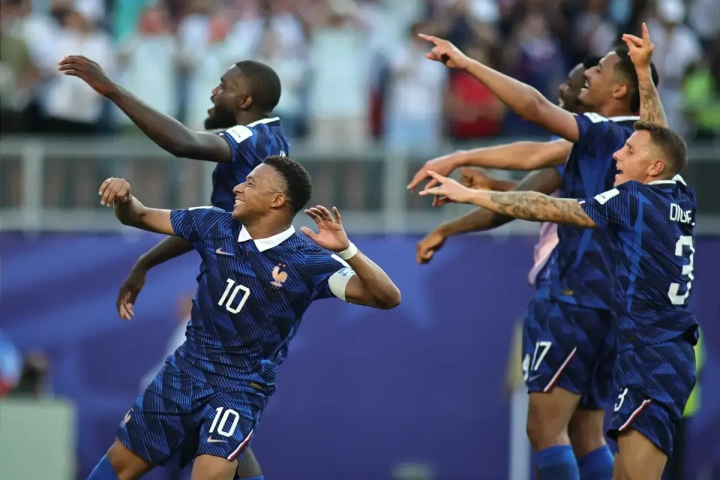
Navigating the opening phases of the competition has perfectly illustrated the overwhelming quality and tactical versatility inherent within Didier Deschamps’ squad. The French national team has arguably been the most convincing side in the entire tournament, boasting a flawless record of five victories from five matches. Throughout their campaign, they have recorded an astonishing fourteen goals while conceding a mere two, establishing the best combined attacking and defensive record of any nation remaining in the competition.
Their preliminary campaign was an exercise in systematic dominance. Placed in Group I, they laid down an immediate marker by dispatching Senegal, before comprehensively dismantling Iraq and a rotated Norway side to secure the top spot. Moving into the knockout rounds, they demonstrated their ruthless attacking efficiency with a commanding 3-0 victory over European rivals Sweden in the Round of 32.
However, their progression through the Round of 16 provided a remarkably severe physical and mental examination. Facing a notoriously stubborn and physical Paraguay side, France were dragged into a gruelling, attritional battle. Demonstrating vital patience and maturity, Deschamps’ men maintained their composure against a deep defensive block, eventually finding the decisive breakthrough in the 70th minute to secure a hard-fought 1-0 triumph. That gritty performance proved that this French iteration possesses the vital psychological resilience required to win ugly when their typical fluid passing game is heavily disrupted.
Mbappé’s Golden Quest
While football is fundamentally a collective endeavour, the global audience will be irrevocably drawn to the monumental individual performances of France’s talismanic captain. Kylian Mbappé arrived in the United States with his golden touch firmly intact, already registering a staggering seven goals in just five starts. The formidable forward is fiercely hunting the tournament’s Golden Boot, while simultaneously enhancing his legendary status on the global stage.
Averaging more than three shots per match, Mbappé has now amassed an incredible 19 World Cup goals across his career. His unparalleled ability to unlock deep defensive lines with a sudden burst of explosive pace or a moment of individual brilliance remains France’s most devastating weapon. Crucially, he is brilliantly supported by a dynamic, interchangeable attacking cast. The trickery of Ousmane Dembélé, the creative vision of Michael Olise, and the relentless energy of Bradley Barcola ensure that opposition defences cannot afford to solely focus their attention on the French captain without leaving themselves critically exposed elsewhere.
Morocco’s Unyielding Armor
Operating on an entirely different spectrum of tactical philosophy, the Moroccan camp arrives in Massachusetts fuelled by an extraordinary sense of momentum and invincibility. The North African heavyweights have firmly established themselves as one of the most impenetrable units in international football. Remarkably, the Atlas Lions currently boast a staggering 34-match unbeaten streak in regulation time across all international fixtures, a record that underscores their phenomenal defensive organisation and collective work ethic.
Their route to the quarter-finals has been a testament to unyielding character. Following a tightly contested draw in their opening group match, they scraped past a resilient Scotland side before steamrolling Haiti to easily secure progression. The knockout phase presented a dramatic escalation in difficulty, requiring a tense, emotionally exhausting penalty shootout victory over the Netherlands in the Round of 32 to keep their dreams alive.
However, it was their performance in the Round of 16 that truly served notice to the rest of the tournament. Facing a spirited Canadian side buoyed by fervent home support, Morocco delivered a clinical masterclass to run out 3-0 winners. Goalkeeper Yassine Bounou remains a calming, authoritative presence between the posts, while the defensive line, anchored by the experience of Achraf Hakimi and Noussair Mazraoui, has consistently denied crucial space to opposition attackers throughout the North American summer.
The Midfield Engine and Creative Spark
Beyond their famed defensive solidity, Morocco’s progression has been heavily driven by an exceptionally well-balanced midfield unit. The double pivot of Neil El Aynaoui and 18-year-old sensation Ayyoub Bouaddi has been one of the undisputed revelations of the tournament. The teenage Bouaddi has displayed a level of composure in possession and positional awareness that completely belies his youth, allowing the team to dictate the tempo and successfully disrupt opposition passing lanes.
Further forward, the creative burden rests squarely upon the shoulders of Brahim Diaz. The Real Madrid playmaker has been in scintillating form, pulling the strings in the final third. Diaz provided two crucial assists in the comprehensive victory over Canada, taking his tournament tally to four, the highest number of assists ever recorded by an African player in a single World Cup campaign. His ability to drift into the half-spaces and seamlessly connect the midfield to the forward line will be essential if Morocco are to breach the formidable French defence.
The Tactical Battleground
Strategically, Thursday’s clash promises a fascinating game of chess on the touchlines. The tactical dynamic is relatively straightforward to anticipate: the European side will inevitably dominate possession and attempt to carefully pick the lock, while their African adversaries will remain highly compact and look to turn the fixture into a gruelling tactical contest.
Morocco have repeatedly demonstrated a profound capacity to slow the tempo of a match, successfully dragging opponents into deep, attritional battles. This deliberate strategy is reflected in their recent statistics; four of their five matches at this World Cup have been level at half-time. They will aim to frustrate the French playmakers, carefully absorbing sustained waves of pressure before springing rapid counter-attacks through the wide channels.
For France, patience will be paramount. The central midfield partnership of Manu Koné and Adrien Rabiot must rapidly circulate possession to stretch the Moroccan defensive block laterally. The defining individual duel will undoubtedly occur on the flank, where the blistering pace of Mbappé will directly collide with his Paris Saint-Germain club-mate Hakimi. That specific matchup on the wing possesses the raw potential to entirely dictate the overall flow and outcome of the contest.
Team News and Squad Availability
At this incredibly punishing stage of a major international summer tournament, physical endurance, hydration, and medical recovery become absolutely critical factors for success. Preparing elite athletes for the unique intensity of World Cup knockout football requires meticulous planning and careful workload management.
Within the French camp, the medical department is carefully monitoring the fitness of forward Marcus Thuram. The attacker is currently listed as a doubt due to an unspecified fitness concern, though the incredible depth of Deschamps’ squad ensures they are well-equipped to manage his potential absence. In defence, Lucas Digne appears to have firmly established himself in the starting lineup at left-back, providing reliable cover and attacking width.
Conversely, Morocco are facing a significant injury headache ahead of the quarter-final. Influential midfielder Ismael Saibari is considered a major doubt after sustaining a hamstring injury during the victory over Canada. His potential absence would serve as a severe blow to their attacking fluency, placing even greater creative responsibility onto the shoulders of Diaz and Azzedine Ounahi. In more positive news for the Atlas Lions, Chadi Riad is expected to be fully fit and available to return to the heart of the central defence.
The Stage is Set
As the 21:00 BST kick-off rapidly approaches, the atmosphere in Foxborough is building towards a magnificent crescendo. The spectacular architectural marvel of the Boston Stadium provides a fittingly grandiose backdrop for a match of this sheer magnitude. Historical records confirm that Morocco have never beaten France in regulation time in a competitive fixture, but historical precedents count for very little when the referee’s whistle sounds in a modern World Cup elimination match.
Every single tackle will carry immense weight, every defensive lapse will be heavily magnified, and every fleeting moment of individual brilliance could permanently define a generation. One supremely talented squad will march onwards into the semi-finals to continue their pursuit of the sport’s greatest prize, while the other will be left to face the crushing reality of elimination. The global footballing audience awaits the outcome with bated breath.